What Is Gravity? Newton's Universal Law Explained
Discover what gravity is and how Newton's law of universal gravitation works. Explore the force that keeps planets orbiting, apples falling, and everyday objects grounded. Learn the formula, examples, and historical insights in this concise guide.
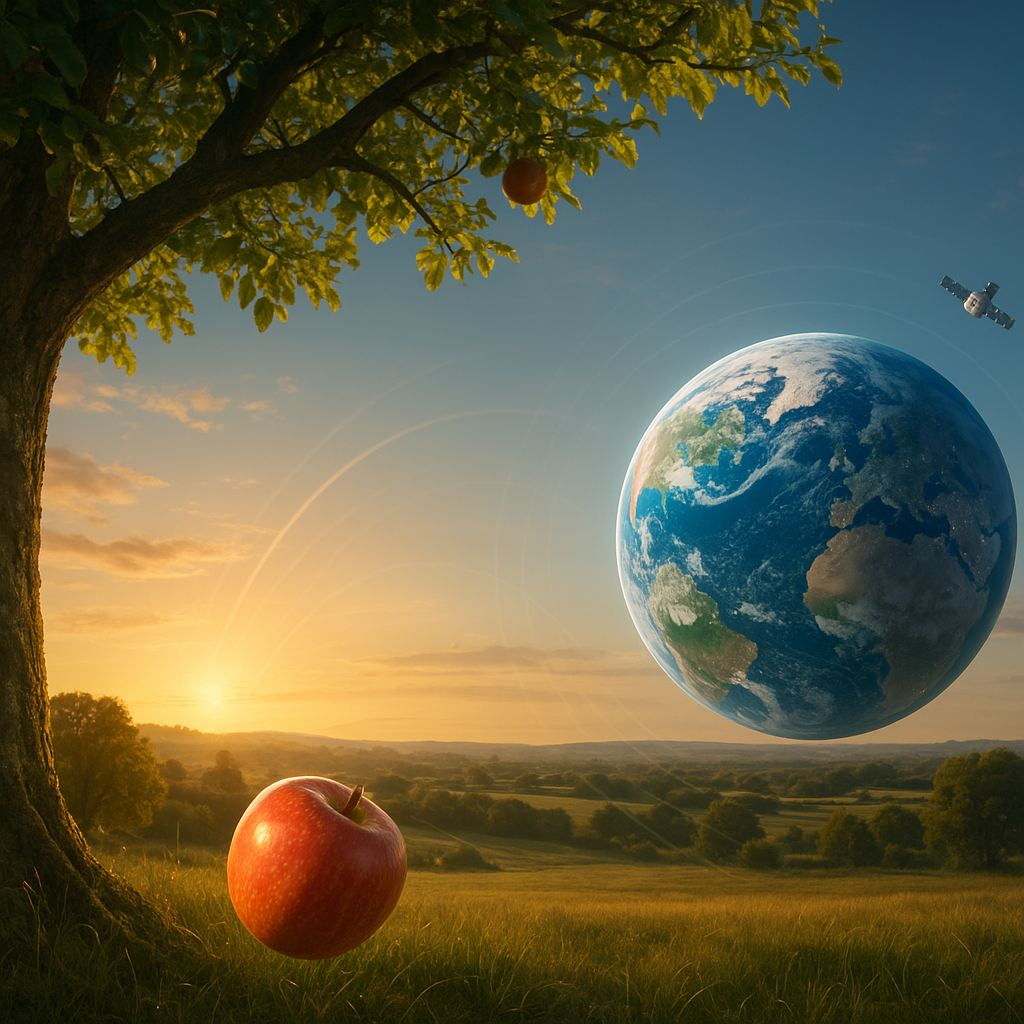
Gravity is the fundamental force that attracts objects with mass toward each other, keeping us grounded on Earth and planets in orbit around the Sun. Sir Isaac Newton formulated the law of universal gravitation in 1687, revolutionizing our understanding of this invisible pull. This law explains how gravity governs everything from falling apples to cosmic structures.
Understanding Gravity as a Force
Gravity, often called yerçekimi in Turkish, is one of the four fundamental forces of nature. It acts between all objects with mass, no matter how large or small, and its strength decreases with distance. Unlike other forces, gravity is always attractive and cannot be shielded. On Earth, we experience it as weight, pulling us downward at about 9.8 m/s² acceleration.
In everyday life, gravity shapes our world: it causes rain to fall, holds the atmosphere in place, and enables sports like basketball. Without it, life as we know it would be impossible, as oceans would float away and we couldn't walk.
Newton's Law of Universal Gravitation
Newton's universal law of gravitation states that every particle in the universe attracts every other particle with a force proportional to the product of their masses and inversely proportional to the square of the distance between them. Published in Philosophiæ Naturalis Principia Mathematica, this law unified terrestrial and celestial mechanics.
The Gravitational Formula
The mathematical expression is F = G (m₁ m₂ / r²), where F is the gravitational force, m₁ and m₂ are the masses of two objects, r is the distance between their centers, and G is the gravitational constant (6.67430 × 10⁻¹¹ m³ kg⁻¹ s⁻²). This inverse-square law means doubling the distance reduces the force to one-fourth.
How Newton's Law Works in Practice
Falling Apple: Legend says Newton observed an apple falling, realizing the same force pulls moons around Earth. The force on the apple is F = G (M_earth * m_apple / R_earth²), explaining acceleration due to gravity.
Planetary Orbits: Planets orbit the Sun because gravitational pull provides centripetal force. For Earth, this balance keeps us at 150 million km away, completing an orbit yearly.
Tides on Earth: Moon's gravity pulls oceans, causing high and low tides twice daily. Sun's influence adds to this, strongest during full and new moons.
These examples show gravity's universality: from micro scales like dust settling to macro scales like galaxies forming.
Historical Context and Impact
Inspired by Johannes Kepler's laws of planetary motion, Newton developed his theory amid the Scientific Revolution. It predicted phenomena like comet paths, verified by Edmund Halley's comet in 1758. The law paved the way for space exploration, from moon landings to satellite launches.
While accurate for most purposes, Einstein's general relativity later refined it for extreme conditions like black holes. Newton's law remains essential for engineering and astronomy.
Key Applications and Conclusion
Space Missions: GPS satellites account for weaker gravity at altitude using Newton's corrections.
Engineering: Dams and bridges designed considering gravitational loads.
Everyday Tech: Accelerometers in phones detect orientation via gravity.
In summary, gravity via Newton's law elegantly explains attraction between masses. Understanding it unlocks the cosmos, from why we don't float away to how stars cluster. For deeper dives, explore relativity, but Newton's insight endures.